Canine remains found in Spain suggests that pet “toy dogs” date back to ancient Rome.
Wikimedia CommonsArchaeologists discovered that Romans kept a tiny dog breed similar to the modern “ miniature frump . ”
When we think of “ toy dogs , ” the image of a renown with a tiny heel nestled in a pocketbook might add up to take care . But a new discovery advise that “ toy pawl ” have existed since the age of the ancient Romans .
An archaeological shaft in Córdoba , Spain , uncovered the remains of a 2,000 - year - quondam tiny dog . A unexampled study of the canine rest suggest that this breed of dog was physiologically like to the small-scale bounder breed we acknowledge today . The sketch is set to bepublished in its totality in the journalArchaeological and Anthropological Sciences .

Wikimedia CommonsArchaeologists discovered that Romans kept a tiny dog breed similar to the modern “toy dogs.”
According to theDaily Mail , a team of Spanish researchers set up that this small heel was only nine inch magniloquent , possess a flat nozzle and diminutive limbs , and had reached adulthood at the clock time of its death .
Although researchers could not identify what the dog ’s external appearance may have been — such as the people of color and grain of its pelt — the low height of its full - spring up size and characteristic of its skeleton closely resemble that of the modern Pekingese and Chihuahua “ toy ” breeds .
Researchers believe that the eyetooth remains are one of the oldest recognized cause of micromorphic or tiny pawl within the Roman Empire .
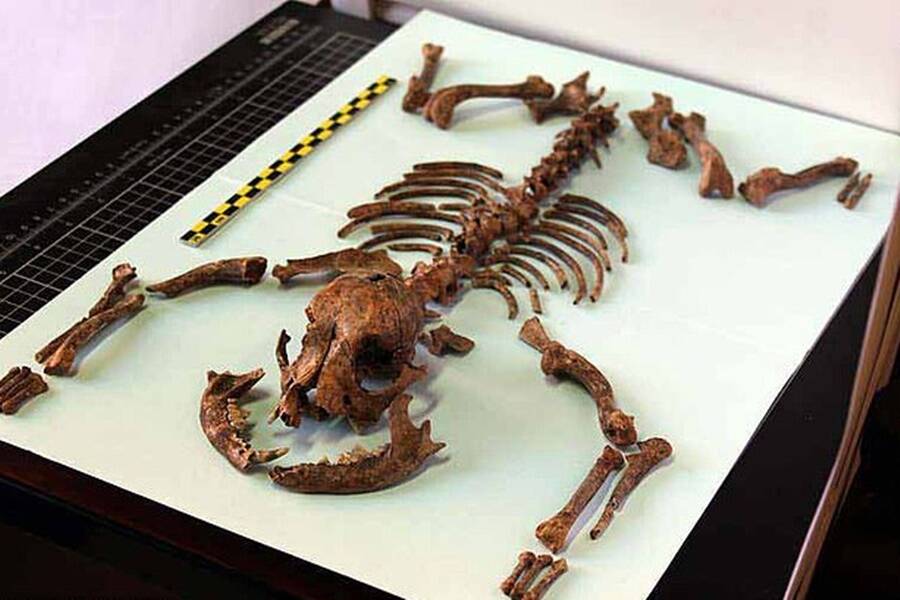
Martínez Sánchez et alFossils of the Roman dog reveal its tiny stature and a healthy diet similar to its owners.
Martínez Sánchez et alFossils of the Roman dog reveal its diminutive stature and a healthy dieting similar to its possessor .
Sadly , judging by the condition of its bones , the dog ’s neck appears to have been deliberately snapped , perchance so it could be sacrificed follow the sudden demise of a family member . The remains of the dog were indeed launch near a human burial web site inside the previous Roman cemetery of Llanos del Pretorio located in Spain .
Dogs of the Roman Empire were antecedently call up to be mainly used for practical purposes like hunting and guarding , but cuspid forfeit was also a common practice in Grecian and Roman rites . They believed this drill allowed them to compensate tribute to the deities of the underworld and could put off impend death .

Martínez Sánchez et alThe canine bones are the oldest evidence of a tiny dog breed existing at the time of the Romans.
However , some historical track record hint that dogs were treated as darling pets among the Romans as well .
In his bookNaturalis Historia , Pliny the senior described how a lapdog could be used as an effective remediation for a womanhood experiencing stomach cramp if it was held nearly against the body — kind of like how we soothe New tum aches with a heating launch area .
Based on interrogatory of its teeth , the dog-iron found in Córdoba come out to have savor a very standardized diet to its owners . It seems likely that the dog had been observe as a pet before it was put to death as a sacrificial offering .
“ The being of small dogs as darling , objects of tenderness and special consideration for their owner , has been known since classical ancientness , a fact support by texts , epigraphy and iconography,”saidRafael M. Martínez Sánchez , an archeologist from the University of Granada and a co - author of the novel study .
Martínez Sánchez et alThe canine castanets are the old grounds of a tiny dog breed live at the time of the Romans .
psychoanalysis of the wiener bones suggests that the stock did not initiate from the orbit where it was discovered . Rather , the scientist believe that it arrive from thousands of sea mile east of its concluding resting place . It would also seem there was a long - distance trade of “ plaything dogs ” happening across the imperium .
Martínez Sánchez and his squad believe this bounder trade could have been an extension of the Romans ’ habit of transporting “ alien ” animals — like ostriches and elephants — across long distances for their entertainment , akin to how some rich citizenry in the innovative existence buy wild animals for their personal solicitation .
Finally , it look like the toy dog dog had a companion , as researcher receive grounds that the dog was significant at the time of its destruction .
Next , get a line whypuppies were used for sacrifices in ancient China instead of humansas spritual sacrifices and meetDogor , the mummified wolf - dog ascendent that died 18,000 year ago in the Siberian permafrost .
