When you purchase through links on our site , we may earn an affiliate military commission . Here ’s how it work .
TheJames Webb Space Telescope(JWST ) has spied a sister , sun - like star barf out supersonic streams of gas and debris into blank , triggering visually stunning shockwaves that investigator say " bet like lightsabers . "
The newly form star , or protostar , is not actually visible in thelatest JWST photo . But scientist know it is situate in the middle of the dark part between the two luminous rivers of outflowing gas and dust , know as bipolar jets , that stream from the growing star mass , named Herbig - Haro 211 ( HH 211 ) . ( A Herbig - Haro object is a region of a nebula illuminated by a newborn virtuoso . )
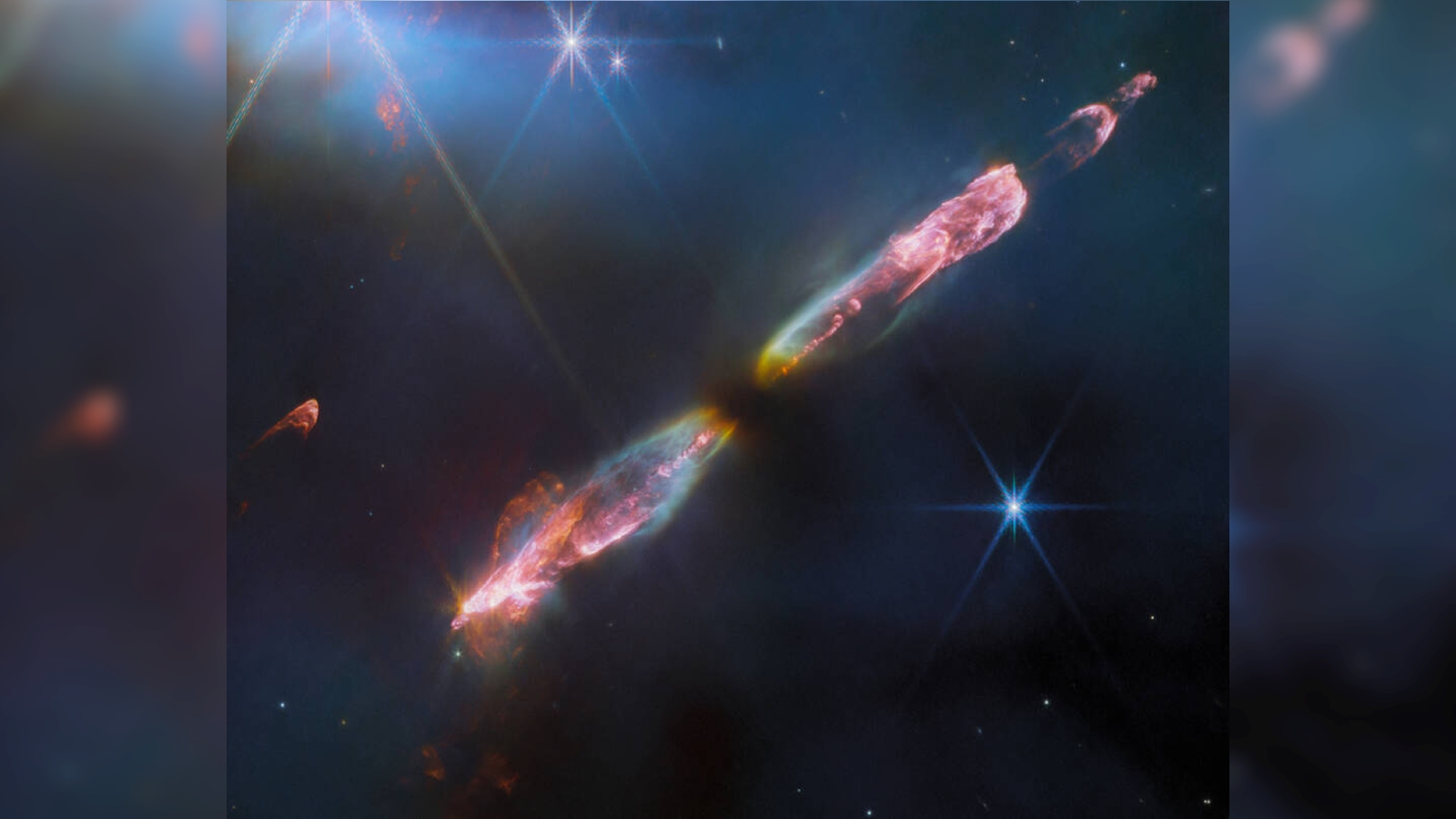
The growing, sun-like protostar HH 211 shoots out a pair of luminous jets of gas and dust that form vibrant shockwaves as they collide with gas surrounding the baby star.
HH 211 is located around 1,000 light - year from Earth in the Perseus configuration and was bring out in 1994 . free-base on the sizing of the jets , the protostar is likely only a few thousand years old and roughly 8 % as massive as thesun , according toNASA . However , the mini headliner will grow to around the same size as the sun over the next few million years . This suggest that our own star may have once looked an awful lot like HH 211 .
In a late study , published Aug. 24 in the journalNature , researchers analyzed the new photo of HH 211 to square off what the K are made of .
Related:35 jaw - dropping James Webb Space Telescope see

A closer look at the luminous polar jets and the vibrant shockwaves they created.
The beam of issue can " radiate with lighter from many different atoms and molecules " that get excited as they collide with the hem in clouds of gas , study lead-in authorTom Ray , an astrophysicist at the Dublin Institute for Advanced Studies , say in astatement . But the JWST ’s near - infrared camera make it much easier to distinguish between the jets ' constituent , he added .
The infrared images intimate the jets are mostly made from molecules — two or moreatomsconnected by a chemical bond — including carbon monoxide , silicon monoxide and molecular hydrogen . This surprise the researchers , who look that , like other bipolar jets , HH 211 would predominantly be made from individual atoms or ions .
The team believes that the jets teem atom , rather of atom and ions , because the material is flowing out comparatively lento . Faster speeds likely break mote aside into their single mote and ion . It is " presently a mystery " why the jet of HH 211 are slower than other bipolar jet , Ray said .

come to : Can the James Webb Space Telescope really see the past ?
Another noteworthy part of the raw trope is the " wiggling " tendrils of gas and dust located through the center of each jet-propelled plane ’s base ( the part nearest the protostar ) . This odd statistical distribution of matter , which is mirrored across both fountain , could hint that the protostar has an unsolved binary star — another protostar with the potential difference to grow into a stellar companion , according toNASA . However , this hypothesis require further probe .
— James Webb Space Telescope capture star going supernova in a glary swarm of dust

— Stunningly perfect ' Einstein pack ' capture by James Webb Space Telescope
— James Webb Space Telescope finds the faint extragalactic nebula ever detected at the dawn of the creation
The level of contingent JWST captured is unprecedented . The new photo has a spacial firmness that is between five and 10 clock time higher than any other image of HH 211 , NASA noted . This is another deterrent example of how JWST can unlock further mystery of already well - studied cosmic social system , Ray say .

Last week , JWST also made headline afterspotting potential sign of extraterrestrial life history on an exoplanetlocated around 120 light - eld from Earth .


